
How to Use AI for Keyword Research (My Real Workflow)
I remember the exact moment I realized I had been doing keyword research wrong for almost a year.
I was sitting at my desk, three tabs open, two cups of cold coffee nearby, staring at a spreadsheet full of phrases I had basically invented from thin air. No real data. No community insight. Just guesswork dressed up as strategy. My traffic reflected exactly that.
When AI tools started becoming genuinely useful for content work, I thought the problem was solved. Type in a topic, get a keyword list, done. But that approach failed me just as badly. The suggestions were safe, obvious, and already owned by websites with years of authority I could not compete with.
What actually worked came later, after a lot of trial and rethinking. Using AI not as a shortcut, but as a research partner that processes information faster than any human can manually. That shift changed the quality of every site I have worked on since. This article breaks down exactly how that process looks in practice.
Start With What People Are Struggling With
One thing that became obvious early on is that the best keyword opportunities hide inside frustration. Real frustration. The kind people type into forums at midnight when their sourdough collapsed again or their plant mysteriously died despite perfect care.
Instead of asking AI for a keyword list, I started feeding it actual forum threads, Reddit discussions, or comment sections from popular blogs in my niche. Then I asked it to identify specific pain points those communities kept mentioning but nobody had written a proper article about.
From my experience, this approach surfaces long-tail phrases that bigger sites completely overlook. A long-tail phrase is simply a more specific search query, usually three or more words. Smaller search volume, yes. But the people using those phrases are far more focused and ready to engage with what you wrote.
Here is a real example. A small indoor gardening site I worked on was chasing “best indoor plants.” Completely pointless target for a new site. So instead, I had AI scan Reddit threads about plant care failures. It kept flagging complaints about white mold growing on clay pots. That led to the phrase “how to clean mold off terracotta pots safely.” Very niche. But it pulled in consistent, targeted visitors within weeks because no major publication had touched the topic properly.
Why Search Intent Matters More Than Volume
Traffic numbers mean nothing if the person searching wants something completely different from what you wrote. This is where a lot of content creators quietly fail, myself included in the early days.
Search intent answers one simple question: what does this person actually want right now? Some people want a quick definition. Others want to compare products before spending money. Some just need step-by-step instructions. If your article format does not match what the searcher expects, rankings suffer regardless of how well the piece is written.
AI can usually sort keywords by intent surprisingly well. Paste a raw list of 50 phrases and ask it to separate informational, investigational, and transactional categories. It takes seconds and saves real strategic headaches down the line.
After testing different approaches, one lesson stuck permanently. Never try to rank a blog post for a keyword where every top result is a product page. I spent weeks trying to rank an article targeting a phrase with the word “software” in it. Solid content. Clean writing. Nothing moved. When I finally ran the keyword through an intent check, the answer was sitting right there. Every competing page was a sales landing page. The audience was not looking for an article. They wanted to compare tools and buy something. I restructured that piece into a comparison guide format, and it eventually broke into the top results.
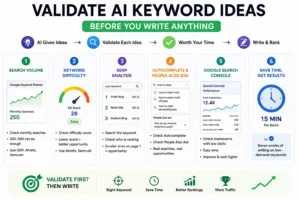
Validating AI Keyword Ideas Before You Write Anything
Finding keyword ideas through AI is only half the job. The other half is confirming those ideas are actually worth your time before a single word gets written.
I discovered this the hard way after publishing three articles targeting AI-suggested phrases that turned out to have almost no real search demand. Good topics. Zero traffic. Wasted weeks.
Here is what a proper validation check looks like now:
Search volume tools. Google Keyword Planner gives a free baseline estimate. For more precise difficulty scores and competitor data, tools like Ahrefs or Semrush are worth checking. You are not chasing huge numbers here. Even 200 to 500 monthly searches on a specific phrase can drive meaningful traffic if competition is genuinely low.
Keyword difficulty. Ahrefs and Semrush both assign a difficulty score to each phrase. For newer sites, targeting terms with lower scores is a smarter entry point than competing against established domains from day one.
SERP analysis. Search the phrase yourself. Look at what is already ranking. Are those pages from massive authority sites or smaller blogs? If smaller sites appear on page one, the opportunity is open. This is something no tool replaces. You have to actually look.
Google Autocomplete and People Also Ask. These two features show real search behavior in real time. Whatever Google suggests when you start typing a phrase, or whatever questions appear in the People Also Ask box, those are terms real people are actively using. AI can generate ideas, but these features confirm what is already happening organically.
Google Search Console. If your site already has some history, Search Console shows which queries are bringing impressions even when clicks are low. Those underperforming phrases are often easier to push into proper rankings than starting fresh with a completely new keyword.
Validation takes maybe 15 minutes per keyword batch. It saves weeks of writing effort on phrases that were never going to move.
Grouping Keywords Into Topic Clusters
Search engines today do not just reward individual articles. They assess entire websites and ask: does this site genuinely understand this subject across the board?
This concept is called topical authority. Building it means writing one main guide on a broad topic and then supporting it with several focused articles that go deep on specific subtopics. Those pieces link together, showing search engines that your site covers the subject with real depth.
Manually organizing hundreds of keywords into this structure used to take me entire weekends. Now I paste a bulk keyword export into AI and ask it to group terms by how closely they relate. Within minutes there is a clear structure: one pillar page surrounded by supporting content.
Here is what that looked like on the coffee hobby site I mentioned. I had over 400 scattered keywords sitting in a spreadsheet with no obvious pattern. After running them through an AI clustering prompt, 12 terms grouped naturally around “espresso extraction problems.” What surprised me most was how specific those supporting phrases were. This is roughly what that cluster looked like:
| Pillar Topic | Supporting Keywords |
|---|---|
| Espresso Extraction Problems | Why does my espresso taste bitter |
| Espresso Extraction Problems | Sour espresso after pulling a shot |
| Espresso Extraction Problems | What causes channeling in espresso |
| Espresso Extraction Problems | Uneven extraction in portafilter |
| Espresso Extraction Problems | How to fix thin espresso crema |
Each of those supporting phrases represented a distinct article. I wrote one core troubleshooting guide and four shorter pieces targeting the most searched supporting terms. Within about two months, organic traffic across that whole section grew steadily. No paid promotion. Just a tightly linked content structure built around real search patterns.
The cluster approach also changed how I thought about internal linking. Every supporting article pointed back to the main guide. The main guide linked forward to each supporting piece. That web of connections is exactly what search engines look for when deciding whether a site genuinely understands a topic.
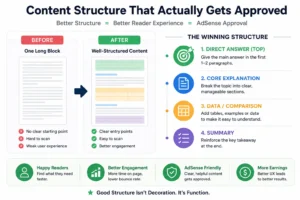
Content Structure That Actually Gets Approved
Here is something that does not get said often enough. The way an article is structured affects monetization approval just as much as the topic itself.
I learned this watching a colleague go through two failed AdSense reviews before we figured out the actual problem. The content was not thin. The topics were fine. The issue was that every article was one long block of text with no visual entry points. A reader landing on any page had no obvious place to start, no table to scan, no clear answer sitting near the top.
What changed things was treating structure as a reader service, not a formatting checkbox. A direct answer in the opening paragraph tells the reader they are in the right place. A comparison table gives them something to reference without reading every sentence. Clear subheadings let someone skip to the section they actually need.
I now build outlines before writing anything. AI helps draft that structure quickly, sectioning the content into: a direct answer up top, the core explanation broken into manageable chunks, a data or comparison section where relevant, and a summary that reinforces the main point. The writing itself stays human. But the skeleton gets built fast.
One thing worth noting: after restructuring those articles, my colleague’s time-on-page metric improved noticeably, and the application cleared on the next submission. Not because the words changed dramatically, but because the page finally made sense to a reader arriving cold.
Structure is not decoration. It is function.
Where the Human Element Cannot Be Replaced
Over time, the biggest lesson has been straightforward: AI accelerates research but it cannot replace judgment.
The first time I ran a fully automated keyword and content pipeline, the outcome was disappointing. Safe, predictable terms. Outlines that were technically correct but had no personality. Traffic from those articles stayed completely flat for months.
What shifted things was stepping back into the process personally. I reviewed every keyword suggestion by hand. I discarded anything that felt generic or recycled. I rewrote every outline to include something real, a specific mistake I had made, an observation nobody else was drawing, a comparison that came from actual testing.
That human layer separates content that climbs from content that just sits there.
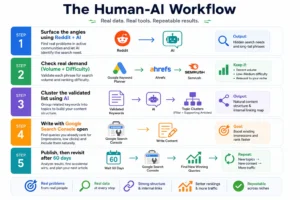
The Human-AI Workflow (With the Actual Tools I Use)
Most workflow guides stop at “validate your keywords.” Here is what that actually looks like step by step, with the specific tools involved at each stage.
Step 1: Surface the angles using Reddit and AI together.
Go to Reddit and find the two or three most active communities in your niche. Look at posts from the past three to six months. Copy the thread titles and top comments that describe a recurring problem. Paste that text into AI and ask it to identify the underlying search need. This combination surfaces phrases that purely tool-based research almost never finds.
Step 2: Check real demand using Google Keyword Planner or Ahrefs.
Take the phrases AI surfaces and run them through Google Keyword Planner for a free volume estimate. If you have access to Ahrefs or Semrush, check the keyword difficulty score alongside it. Anything with a difficulty score manageable for your site’s current authority and at least a modest monthly search count is worth keeping.
Step 3: Cluster the validated list using AI.
Once you have a trimmed list of phrases that actually have demand, paste them back into AI and ask it to group them by topic similarity. This gives you a natural content structure: one main pillar page and several supporting articles, all linked together. No manual spreadsheet sorting needed.
Step 4: Write with Google Search Console open in another tab.
Before drafting, check Search Console for any related queries your site already gets impressions for but low clicks on. Those existing phrases can be worked naturally into the new content, which often gives a ranking lift faster than targeting a completely fresh keyword from scratch.
Step 5: Publish, then revisit after 60 days.
Check Search Console again. Look at which queries drove impressions for the new article. Some of those will be phrases you never targeted intentionally. Those accidental wins often point toward the next article topic, and the cycle continues.
This is not glamorous. But it is repeatable, and it works across different niches because it is built on real data at every stage rather than assumptions.
Final Thoughts
AI can dramatically speed up keyword research, but the biggest gains come from pairing automation with human judgment. These tools are excellent at spotting patterns, clustering ideas, and uncovering angles that manual research would take days to find. What they cannot do is understand your specific audience, your niche context, or the subtle things that make one keyword worth chasing and another worth skipping.
Every successful content strategy I have built involved the same combination: AI for the heavy lifting, real search data for validation, and firsthand experience for the final call. The writers and site owners who treat AI as a thinking partner rather than a content machine consistently end up with more targeted, more useful, and better-ranking content than those who let it run on autopilot. Start there, and the opportunities that most competitors overlook will become far easier to spot.

FAQs
Can AI alone handle my entire keyword research process?
Not effectively. AI handles pattern recognition and bulk analysis well, but it has no awareness of what is genuinely trending inside specific communities right now. Pairing AI analysis with manual research and real search volume data consistently produces stronger results.
How do I know if a keyword has the right intent for my article format?
Search the phrase yourself and look at the top five results. If they are all blog posts, write a blog post. If they are all product pages, a comparison guide will serve you better. The format of what already ranks tells you what the audience actually wants to find.
Is AI-assisted content against Google AdSense policies?
Google evaluates content based on quality, originality, and genuine value to readers. Content that is thin, repetitive, or lacks real insight can be flagged regardless of how it was produced. Adding original analysis, honest examples, and useful structure is what keeps content within policy guidelines.
How many keywords should one article realistically target?
One primary keyword per article works best. Three to five closely related phrases used naturally throughout the content can support it. Forcing too many unrelated terms into a single piece typically hurts both readability and search performance at the same time.