
How to Create and Sell an Ebook Online
Most people overestimate how hard it is to publish an ebook and underestimate how hard it is to sell one.
Writing a 15,000-word guide on something you know well is genuinely achievable in a few focused weeks. Getting a stranger to pay for it is the part that actually requires a plan, and it is the part most first-time ebook creators skip entirely. They finish the writing, format it into a PDF, post it somewhere, and then wonder why nobody is buying.
While helping someone set up their first digital product launch last year, I watched this exact pattern play out. The writing was solid. The product page was an afterthought built in twenty minutes the night before launch. It showed.
This guide covers the full process, from picking a topic that will actually sell, through writing and formatting, to choosing a platform and pricing it correctly. Every step here reflects what actually moves an ebook from finished file to paying customers, not just the mechanics of getting a PDF online.
How This Guide Was Built This process draws on direct experience helping solopreneurs launch digital products, along with research into platform fee structures, pricing data, and conversion patterns across Gumroad, Etsy, and Amazon KDP. Steps reflect what consistently led to actual sales rather than just a published file sitting unsold.
Step 1: Pick a Topic People Are Already Trying to Solve
The biggest mistake beginners make is choosing a topic because they find it interesting, not because anyone is actively searching for a solution to it.
An ebook sells when it answers a specific, urgent question someone already has. “A guide to gardening” is too broad and too crowded to compete against established resources. “How to keep a vegetable garden alive through your first Pakistani summer” is narrow enough that the right person searching for exactly that will find real value, and will pay for it.
During research into what makes digital products convert, I found that the ebooks performing best are almost always solving a problem the creator personally solved first. Not theoretical knowledge. Lived experience translated into a guide.
A few ways to validate a topic before writing 15,000 words:
- Search the topic on Google and see if people are asking related questions in forums or comment sections
- Check if there are paid courses or ebooks already selling on the same topic, since competition usually signals real demand
- Ask your existing audience, email list, or social following directly what they are struggling with
- Look at what questions repeatedly show up in your own DMs or client conversations
One thing that became obvious after looking at several successful first-time ebook launches: niche and specific outperforms broad and ambitious almost every time. A focused 8,000-word guide solving one clear problem regularly outsells a sprawling 40,000-word book trying to cover everything.
Step 2: Outline Before You Write a Single Page
Skipping the outline is how most ebooks end up unfinished or, worse, finished but disorganized in a way readers notice immediately.
A useful structure for most how-to and guide-style ebooks follows a simple shape: introduce the problem and why it matters, walk through the solution in clear sequential steps, address common obstacles or mistakes along the way, and close with next steps or a quick reference summary.
From my experience watching first-time creators get stuck, the outline stage is where most stalled projects actually die. Writing without a map leads to circling the same points repeatedly or losing momentum halfway through. A clear outline, even a rough one, turns writing into filling in sections rather than staring at a blank document wondering what comes next.
Tools genuinely help here. AI writing assistants like Claude can take your core idea and generate a structured outline you then refine, which removes a significant chunk of the blank page problem before any actual writing begins.
Step 3: Write in Focused Sessions, Not One Marathon
Most ebooks fail to get finished, not because the writer lacks knowledge, but because they try to write the whole thing in a few exhausting sessions and burn out before reaching the end.
What worked consistently across the launches I watched closely was breaking the manuscript into sections of 1,500 to 2,000 words and treating each as its own short writing session. A 12,000-word ebook becomes six to eight manageable sittings rather than one overwhelming project.
After comparing finished versus abandoned ebook projects, the pattern was clear. Writers who set a specific, small daily or weekly word target finished. Writers who set vague goals like “work on it when I have time” mostly did not.
AI tools can speed up specific parts of this process without replacing the actual writing. Using Claude or ChatGPT to draft a rough first pass of a section, then rewriting it in your own voice and adding your specific examples and insight, tends to move faster than starting from a completely blank page every session.
Step 4: Format It So It Looks Like a Real Product
A great ebook with poor formatting reads as unfinished, even if the content is genuinely strong. Formatting is not decoration. It is part of what someone is paying for.
The essentials that matter: a clean cover image, consistent heading structure throughout, readable font size and line spacing, a working table of contents for anything over 20 pages, and page numbers if you are delivering a PDF.
Canva handles ebook layout well through its free plan, with templates specifically built for ebook formatting that require no design background to use effectively. For the cover specifically, this matters more than most first-time creators expect, since the cover is often the only thing a potential buyer sees before deciding whether to click through.
A nutrition coach I know spent an entire weekend on the actual writing and then almost rushed the formatting in under an hour before launch. A friend convinced her to slow down and rebuild the cover and layout properly using Canva templates. The difference in how the finished product looked was substantial, and she later said the polished version was what made her comfortable actually promoting it publicly.
Quick Formatting Checklist
- Cover image sized correctly for the platform you are using
- Table of contents with working internal links if delivering as PDF
- Consistent font and heading style throughout
- Page numbers included
- File exported as a properly compressed PDF, not an oversized raw file
Step 5: Choose Where to Sell It
The platform decision affects fees, audience reach, and how much control you have over pricing and branding. None of these are universally best. Each fits a different situation.
Gumroad is the most straightforward option for a first ebook. Setup takes under an hour, there is no upfront cost, and the platform takes a percentage of each sale rather than charging a monthly fee. It works well when you already have an audience, whether through social media, an email list, or a blog, since Gumroad does not bring you traffic on its own.
Etsy works differently. It has built-in shopper traffic actively searching for digital products, which matters if you do not yet have an audience of your own. The tradeoff is more competition and listing fees per item, along with a more rigid product page format.
Amazon KDP fits specifically for ebooks formatted in a traditional book style, particularly nonfiction guides and how-to content. It gives access to Amazon’s enormous existing customer base, but takes a meaningful royalty cut and requires following Amazon’s specific formatting requirements closely.
Platform Comparison for Selling Ebooks
| Platform | Built-in Traffic | Fees | Best For |
|---|---|---|---|
| Gumroad | None (you bring traffic) | ~10% per sale | Creators with an existing audience |
| Etsy | High | Listing fee + ~6.5% transaction fee | No existing audience, niche/visual topics |
| Amazon KDP | Very high | 30–70% royalty cut depending on pricing | Traditional book-style nonfiction guides |
A freelance writer launching her first ebook on freelance pricing strategy chose Gumroad specifically because she had built an email list of around 800 subscribers over a year of consistent newsletters. Her first launch week generated more revenue than a month of her freelance client work, almost entirely because the audience already trusted her before the product existed.
For a deeper comparison of two of the most common starting platforms, the Etsy vs Gumroad breakdown covers fee structures and audience differences in more detail. And for a step-by-step walkthrough specifically on Gumroad setup, this guide to selling digital products on Gumroad is worth reading before your launch.
Step 6: Price It Like a Product, Not a Favor
One thing that became obvious after watching several first-time launches: most beginners underprice their ebook out of nervousness about whether anyone will pay at all.
A genuinely useful, focused ebook solving a real problem typically sells in the $9 to $29 range, depending on depth and the specificity of the audience. Pricing under $5 often signals low perceived value rather than accessibility, and pricing it as “pay what you want” tends to produce lower average revenue than a clear, confident price point.
What matters more than the exact number is matching the price to the depth of the transformation the ebook delivers. A short 20-page guide solving one tactical problem fits comfortably at $9 to $15. A comprehensive 80-page guide walking through an entire process from start to finish can reasonably sit at $25 to $49.
From my experience, testing two price points in the first few weeks, rather than guessing once and leaving it static, gives a clearer signal of where the market actually values the product.
Step 7: Build a Simple Launch, Not a Complicated One
The product page itself does a significant amount of selling work, often more than people expect from a single page of text and a buy button.
A product page that converts typically includes a clear headline stating exactly what the buyer gets, a short description of the specific problem it solves, a brief outline of what is covered, and some form of social proof once you have early customers, even just a few testimonials.
After comparing high-converting and low-converting first launches, the consistent difference was specificity. Pages that said “a guide to better productivity” sold worse than pages that said exactly what the reader would walk away knowing how to do.
A Simple Launch Sequence That Works
- Announce the upcoming ebook to your existing audience a few days before launch, building light anticipation
- Launch with a clear product page and a direct link, not buried in a longer post
- Follow up two to three days later with a reminder for anyone who saw it but did not buy
- Share a specific insight or excerpt from the ebook publicly, giving a preview of the value inside
You do not need a complex funnel or paid advertising for a first ebook launch. A clear product, a warm audience even if it is small, and a direct, confident pitch covers most of what actually drives early sales.
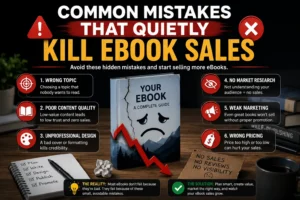
Common Mistakes That Quietly Kill Ebook Sales
The most common mistake is launching to silence, meaning posting the product once with no follow-up and assuming visibility happens automatically. Most sales on a first launch come from people seeing the offer more than once across a few days.
A second frequent mistake is writing the ebook before validating that anyone wants it, which leads to a polished product nobody was asking for. Validating the topic first, even informally, protects the time investment that goes into writing.
A third mistake is treating the cover and formatting as an afterthought. Buyers form a judgment about quality before reading a single page, based entirely on how professional the listing and cover look.
Who This Approach Works Best For
This process fits well for consultants, coaches, freelancers, and content creators who already have some accumulated expertise and at least a small existing audience, even a modest one. The audience does not need to be large. A focused 500 to 1,000 person email list or social following is often enough to generate meaningful first-launch revenue if the topic and offer are sharp.
It works less well as a strategy for someone starting completely from zero with no audience and no existing content, since in that case the harder problem to solve first is audience building, not ebook creation. If that describes your situation, building toward content writing or a consistent blog through resources like the complete SEO guide for beginners is often a more realistic starting point before a paid ebook launch.
Frequently Asked Questions
Q1. How long should a first ebook be?
There is no fixed requirement, and shorter is often better for a first product. A focused 6,000 to 12,000 word guide solving one specific problem typically outperforms a sprawling, unfocused longer book, both in completion rate for the writer and in conversion rate for buyers who want a clear, fast solution.
Q2. Do I need design skills to make an ebook look professional?
No. Tools like Canva include ebook-specific templates on the free plan that require no design background. Choosing a clean, simple template and staying consistent with fonts and spacing throughout produces a professional result without needing prior design experience.
Q3. Which platform is best if I have no existing audience at all?
Etsy tends to work better in this situation because it has built-in shopper traffic actively browsing for digital products. Gumroad and Amazon KDP both rely more heavily on you bringing your own audience or running advertising to generate visibility.
Q4. How much does it actually cost to create and sell an ebook?
The direct costs can be close to zero. Writing tools like Claude have usable free plans, Canva’s free plan covers formatting and cover design, and Gumroad has no upfront listing fee, only a percentage taken per sale. The real cost is time, not money, for most first-time creators.
Q5. Can AI tools write the entire ebook for me?
Using AI to write the entire manuscript without significant editing and personal input tends to produce generic content that does not reflect real experience, which readers notice and which can affect both trust and reviews. AI tools are most useful for outlining, drafting rough first passes, and overcoming the blank page, with the final voice, examples, and insight coming from the actual writer.
Final Thoughts
An ebook is one of the more accessible digital products to create because it requires no inventory, no shipping, and no specialized technical skill beyond basic formatting. The barrier most people actually face is not the writing. It is treating the selling side with the same seriousness as the writing side.
Pick a specific problem you have genuinely solved. Outline it before writing. Write it in manageable sessions rather than one overwhelming push. Format it so it looks like something worth paying for. Choose the platform that matches your situation. Price it with confidence. Launch it more than once.
None of these steps are complicated individually. Most failed ebook launches come from skipping two or three of them, usually the outline, the formatting, or the follow-up after launch, not from any single catastrophic mistake.