
Claude AI vs ChatGPT for Content Writing: A Real-World Comparison
I have been writing content professionally for a while now. Like most writers in this space, I started testing AI tools the moment they became widely accessible. Not to replace my process, but to see how much time they could actually save without hurting quality.
After months of hands-on testing across real client projects, here is what I discovered about Claude AI and ChatGPT. Not the specs. Not the marketing claims. Just what happened when I sat down and tried to get actual work done.
My First Real Test
My starting point was a 1,400-word blog post on sustainable packaging for a small e-commerce brand. I ran the same brief through both tools on the same day.
ChatGPT was fast. The structure was clean, the headers made sense, and the flow was decent. It read like a solid first draft. Nothing wrong, but nothing memorable either.
Claude approached the same brief differently. The intro had a sharper angle. It raised a counterpoint the client had not mentioned. When I read both outputs side by side, the Claude version needed fewer edits to feel like something a person actually wrote.
I realized then that these two tools are not trying to do the same thing, even though they look similar from the outside.
Tone and Voice: Where the Gap Becomes Clear
This matters more than anything else for content writers. Clients pay for voice. Generic copy gets ignored.
ChatGPT defaults to a confident, structured tone. That consistency is genuinely useful for corporate explainers, FAQs, and step-by-step guides. You know what you are going to get, and it is usually serviceable.
Claude feels more considered. It takes the brief seriously in a different way. When I asked it to write in the tone of a weary but enthusiastic travel blogger, it did not produce a travel brochure. The output had real personality baked in.
Real example: A wellness brand piece about burnout. The topic needed warmth without sounding clinical. Claude’s draft opened with something a real person might say on a hard Monday morning. ChatGPT’s version was well-organized but felt like it came from an employee handbook. For that project, the choice was obvious.
How Well Do They Follow Instructions?
Every content writer knows this problem. You write a careful brief with tone, structure, and target reader spelled out. The AI follows about 70 percent of it.
Both tools do this. They just fail differently.
ChatGPT follows structural instructions closely. Tell it exactly how many sections you want, and it delivers. But give it something interpretive like “avoid marketing language,” and corporate buzzwords slip back in anyway.
Claude is better at holding the spirit of a brief. I found this clearly when working on a B2B newsletter series. Eight emails, consistent tone throughout. Claude maintained it. ChatGPT started drifting noticeably by the fourth piece, even with tone guidelines in every prompt.
Real example: A product description brief for a handmade leather wallet. Instructions said “masculine, minimal, no fluff.” ChatGPT returned “crafted with precision and care.” Claude opened with something like “It will outlive the receipts you keep forgetting to throw out.” One of those actually follows the brief.
Long-Form Writing: Who Holds It Together?
Short pieces are a fair fight. Once you go past 1,500 words, the differences become harder to ignore.
ChatGPT produces long content, but it starts repeating itself conceptually. The same idea resurfaces in a new section with different phrasing. By the time I finished editing one 3,000-word draft, I had cut around 400 words that were just earlier points dressed differently.
Claude holds together more cleanly over length. One thing that became obvious after testing both on extended pieces: it keeps track of what it already covered. That said, it can become cautious in a frustrating way. Where you want a direct statement, Claude sometimes delivers three hedged sentences instead.
Neither tool removes the need for a real editor. But Claude tends to reduce structural editing work, while ChatGPT often increases it.
Real example: A freelance pricing guide for a marketing agency. Claude’s 2,800-word draft needed 14 targeted edits before it was client-ready. The same brief on ChatGPT required structural reorganization across three sections on top of content cuts. Roughly double the revision work.
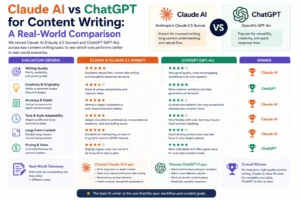
Quick Comparison: Claude AI vs ChatGPT
| What You Need | Claude AI | ChatGPT |
|---|---|---|
| Tone matching and voice work | Strong | Average |
| Speed on structured tasks | Moderate | Fast |
| Long-form coherence | Better | Drifts over length |
| Keyword integration in SEO copy | Natural | Can feel forced |
| Following creative briefs | Interpretive | More literal |
| High-volume batch content | Slower | More efficient |
| Bold, opinionated writing | Needs prompting | More willing |
| Consistency across multiple pieces | Strong | Weaker over time |
SEO Writing: Which Tool Handles It Better?
Neither tool writes SEO content automatically. You still need to supply the keyword, the search intent, and the structure. What differs is how each handles that information.
ChatGPT tends to front-load keywords. Give it a target phrase and it appears in sentence one, sometimes awkwardly. It is checking a box rather than writing naturally. That approach can hurt readability.
Claude treats keywords as part of the meaning rather than a task to complete. Over time, I noticed SEO drafts from Claude needed less rewriting before they read well to both search engines and actual people.
Real example: An intro paragraph targeting “best project management tools for remote teams.” ChatGPT opened with that exact phrase in the first sentence. Claude opened with a short scenario about a remote team missing a handoff, then brought the keyword in naturally by sentence three. For content focused on engagement, Claude’s version was the stronger choice.
Creative vs. Functional Writing: A Practical Split
For functional work like email sequences, service page copy, and product listings, ChatGPT is faster and reliable enough. Speed matters on these projects. The client rarely needs brilliance. They need something competent and delivered on time.
For anything with narrative weight like thought leadership pieces, brand storytelling, or executive ghostwriting, Claude produces better raw material. It takes interpretive risks. When those risks land, the output is closer to what a skilled human writer would produce without prompting.
Real example: A ghostwritten LinkedIn piece for a finance executive on professional setbacks. ChatGPT gave me something motivational and surface-level. Claude gave me a draft with a specific scenario, an honest moment of self-doubt, and a conclusion that felt genuinely earned. That gap matters when you are writing in someone else’s voice.
Honest Limitations of Both Tools
Claude can be too careful. On topics that need a strong take, it sometimes pulls back and adds qualifiers where you need one clear sentence. If you are writing opinion pieces or direct-response copy, you will need to push Claude a bit harder.
ChatGPT gravitates toward optimistic corporate language. Words like “empower” and “game-changing” appear constantly without prompting. I built a short blocklist of terms I paste into every brief just to prevent those defaults from slipping through.
Both tools depend heavily on your prompt quality. The gap between a weak draft and a usable one often comes down to how specific your instructions were, not which tool you used.
Pros and Cons at a Glance
Claude AI
- Stronger tone matching across different voices
- Better coherence in longer pieces
- More natural keyword use in SEO writing
- Can over-hedge on direct claims
- Slightly slower for bulk tasks
ChatGPT
- Fast and consistent on structured work
- Reliable for explainers, FAQs, product guides
- Good for high-volume batch content
- Defaults to generic phrasing without firm prompts
- Loses thread in extended long-form writing
FAQ
Is Claude AI better than ChatGPT for blog writing?
It depends on the blog type. For conversational, voice-driven posts, Claude tends to produce more natural drafts. For structured, keyword-focused articles where speed matters, ChatGPT is a reasonable pick. Test both on your actual content type before settling on one.
Which tool works better for SEO content?
Both support SEO writing when given a clear brief. Claude tends to weave keywords into sentences more naturally, which helps readability alongside search optimization. ChatGPT can place keywords more mechanically, which sometimes reads awkwardly even if the phrase appears in the text.
Can ChatGPT match a specific brand voice?
It can follow tonal instructions reasonably well with detailed prompts. Where it sometimes slips is maintaining that voice across multiple pieces without repeated reminders. Including a short style note in every prompt helps significantly.
Does Claude handle ghostwriting well?
From my experience, yes. It holds perspective and personality across longer pieces better than most comparable tools. When writing in someone else’s voice, Claude stays in character more consistently, which cuts revision time.
Do I still need to edit AI-written content before publishing?
Always. Both Claude and ChatGPT produce drafts, not finished articles. Fact-checking, tone adjustments, and structural edits are still your job. Treat these tools as writing assistants rather than content machines, and the results improve considerably.
Final Thoughts
What I discovered after working with both tools across real client projects is that this is not really a versus situation. It is a routing question.
Claude works better when writing needs personality, long-form coherence, or careful tone-matching. ChatGPT works better when speed, structure, or high-volume output is the priority.
The writers getting the most out of these tools are not picking a winner. They are learning what each tool is actually good at and routing work accordingly. Start with your content type. Match it to the right tool. Prompt with specifics. Then edit properly.
That process, more than any tool choice, is what separates useful AI-assisted writing from copy that reads like it was generated on autopilot.