
How to Learn Faster With AI Without Becoming Dependent on It
The first time I used AI for learning, I got worse results than a basic book. Not slightly worse. Noticeably, embarrassingly worse. I was copying outputs, skimming explanations, and calling it a study session. Two weeks later, I could not explain a single concept without my notes open in front of me.
That failure forced a harder question. Not “how do I use AI better?” but “what does real learning actually require, and where does AI even fit?”
So I spent the next two years testing, breaking, and rebuilding how I study with AI. What follows is that system not a prompt list, but a method for keeping the hard thinking where it belongs: with you.
At a glance — what this system covers: Map the skill first → build layered understanding → struggle before asking → practice under friction → extract before closing
Why Most People Use AI for Learning the Wrong Way
The biggest mistake beginners make is treating AI like a faster textbook. Ask a question, read the answer, feel informed, move on. That cycle feels productive. It usually is not.
The real problem is not the tool. It is the passive role the learner takes. Barbara Oakley’s research on learning science makes this point clearly: information encountered without effortful retrieval tends to decay quickly. So in practice, you are not storing knowledge. You are storing the memory of having seen something. That distinction is bigger than most people expect.
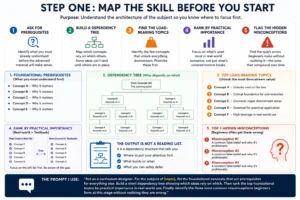
Step One: Map the Skill Before You Start
I used to open courses at chapter one and trust the sequence. That trust was usually misplaced, because curricula are built for average learners, not for my specific gaps.
Now, before touching any material, I spend time mapping the architecture of the subject first. The goal is to understand which concepts are prerequisites, which carry the most weight in real use, and where beginners quietly build broken foundations without realising it.
Here is exactly how I do that mapping:
Ask for prerequisites first before anything else, I want to know what someone must already understand before the advanced material can land. Then I build a dependency tree by asking which concepts rely on which others, because some ideas simply cannot stick until a different idea is already in place. From there, I find the load-bearing topics the concepts that unlock everything downstream and push the rest to later. After that, I rank by real-world importance rather than textbook coverage, because the gap between those two lists is usually where the curriculum has been misleading me. Finally, I ask where beginners tend to go wrong without realising it, those quiet errors that compound silently over weeks.
The output of all this is not a reading list. It is a dependency structure something I can actually navigate.
A colleague once spent four months in a data analysis bootcamp. Solid program, good instructors. She told me afterward that the first two months focused entirely on tools and syntax, while statistical reasoning only came up near the end. When she joined her team, the gaps showed immediately not in her code, but in her judgment about what a number actually meant. Mapping first would have flagged statistical thinking as the foundational concept, not the software sitting on top of it.
Prompt to use for this step:
“Act as a curriculum designer. For [topic], list the foundational concepts that are prerequisites for everything else. Map which ideas depend on which. Rank those foundational topics by practical importance in real-world use. Then identify the three most common misconceptions beginners form at this stage without realising they are wrong.”
Step Two: Build Understanding in Three Passes
There is a specific kind of explanation that feels satisfying but leaves almost nothing behind the simple analogy, the friendly metaphor, the plain-language rewrite. These are useful as entry points. But if you stop there, you end up building an illusion of understanding rather than the real thing.
After testing different approaches, I found that depth comes from processing the same idea through multiple lenses, not from finding the single perfect explanation. So my approach now moves through three distinct passes, and I treat each one as a separate sitting rather than one long session.
The first pass is purely about shape. I ask for the concept explained through something already familiar — not to understand it, but to give my brain an initial anchor. I remind myself that this is just the doorway, not the room.
The second pass strips the analogy away completely. Here I work through how the idea actually operates: its moving parts, the conditions it relies on, how it behaves under normal circumstances. This is where the vocabulary gets technical and the thinking gets slower.
The third pass the one most people skip is about finding where the concept breaks. Every principle has edges where it stops working or produces the wrong result. Understanding those edges is precisely what separates someone who learned something from someone who genuinely understands it.
When I was studying pricing psychology for a project, the first two passes made clean sense. But during the third pass, I found situations where the exact framing that lifted conversions in one context actively reduced them in another. That friction was where the actual knowledge lived. Without pass three, I would have applied the concept confidently and gotten it completely wrong.
Step Three: Resist the Instant-Answer Reflex
About six weeks into a period of heavy AI-assisted study, something uncomfortable became obvious. I was producing decent-looking work and understanding very little of how I was doing it. Outputs looked right. My actual comprehension was shallow.
A quiet pattern had formed. Hit friction, feel stuck, reach for the tool, friction disappears. It felt like progress. But because the thinking was not mine, none of it was sticking in any meaningful way.
The fix was not to use AI less. It was simply to change when I reached for it.
Now, before asking for any help on a problem, I first spend at least fifteen minutes writing down what I currently think is happening my assumptions, my partial reasoning, even a probably-wrong attempt at an answer. Only then do I bring in outside input, and when I do, I share that scratchpad rather than asking for the solution outright. My one question becomes: where exactly does my thinking break down?
That shift changed everything about those exchanges. Instead of replacing my thinking, the conversation started sharpening it.
This connects directly to what researchers call desirable difficulty a concept studied extensively by Robert Bjork at UCLA. His core finding is that making retrieval harder in the short term tends to produce stronger retention over time. So the struggle is not a sign of inefficiency. It is, in fact, the mechanism itself.
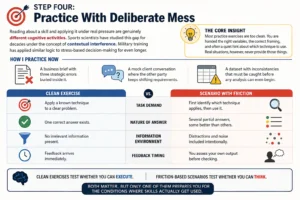
Step Four: Practice With Deliberate Mess
Reading about a skill and applying it under real pressure are genuinely different cognitive activities. Sports scientists have studied this gap for decades under the concept of contextual interference. Military training has applied the same logic to stress-based decision-making for even longer.
Most practice exercises are too clean. You get handed the right variables, the correct framing, often a quiet hint about which technique applies. Real situations never work that way.
So instead of clean exercises, I build scenarios with deliberate imperfection baked in a business brief with three strategic errors buried inside it, a mock client conversation where the other party keeps shifting requirements, a dataset with inconsistencies that must be caught before analysis can begin.
The difference between these two modes of practice comes down to one thing. Clean exercises test whether you can execute a technique when someone has already identified which technique is needed. Friction-based scenarios test whether you can think whether you can identify the problem before solving it, filter noise before acting on signal, and judge your own output before anyone else does.
My brother-in-law runs a small design studio. He told me once that three fictional client roleplays taught him more about managing difficult clients than every book he read on the subject. One simulated client agreed to everything upfront and then reversed all decisions at the final stage. Another rejected work without giving coherent reasons. He had to navigate both situations in real time, with no answer key. That discomfort was not a byproduct of the exercise. It was the point of it.
Step Five: Extract Before the Tab Closes
At the end of every focused learning block, before I close anything, I spend ten minutes on what I call extraction.
Not reviewing. Not summarising. Specifically pulling out the two or three ideas that genuinely shifted something in my understanding, and then rewriting them as questions rather than statements.
Not “spaced repetition improves retention,” for example. Instead, something like: what makes spaced repetition more effective than rereading, and under what circumstances does it actually stop being the right tool?
The question form creates a fundamentally different kind of engagement when you return to it days later. It is harder to fake your way through a question than through a remembered statement. Moreover, the act of writing the question itself forces one more pass through the material before the session ends.
Prompt to use at session end:
“Based on what we covered today on [topic], extract the five most important conceptual shifts. Write each one as a diagnostic question that tests understanding rather than simple recall.”
What This Honestly Requires
None of this is frictionless. The mapping step takes time. The three-pass explanation process is slower than reading a summary. Sitting with hard problems before asking for help feels wasteful when answers are one click away.
The honest trade is this: the approach costs more upfront, and in return, what you build tends to hold up when you actually need it.
Whether that exchange is worth it depends entirely on what you want from the time you invest.
Final Thoughts
AI can genuinely support learning, but only when it supplements your thinking rather than replaces it. The system above is built around a single principle keep the difficult cognitive work on your side of the screen, where it needs to be.
Use AI to map skill structures, challenge your reasoning, create realistic practice pressure, and test understanding instead of consuming answers, and it becomes a legitimately useful tool. Skip that structure, and it mostly produces the feeling of learning without the substance underneath.